
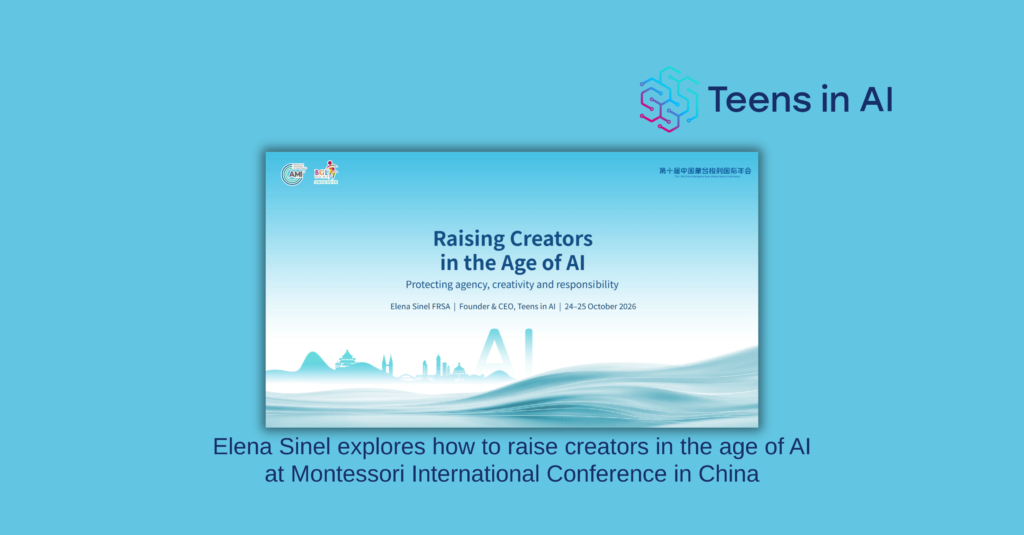
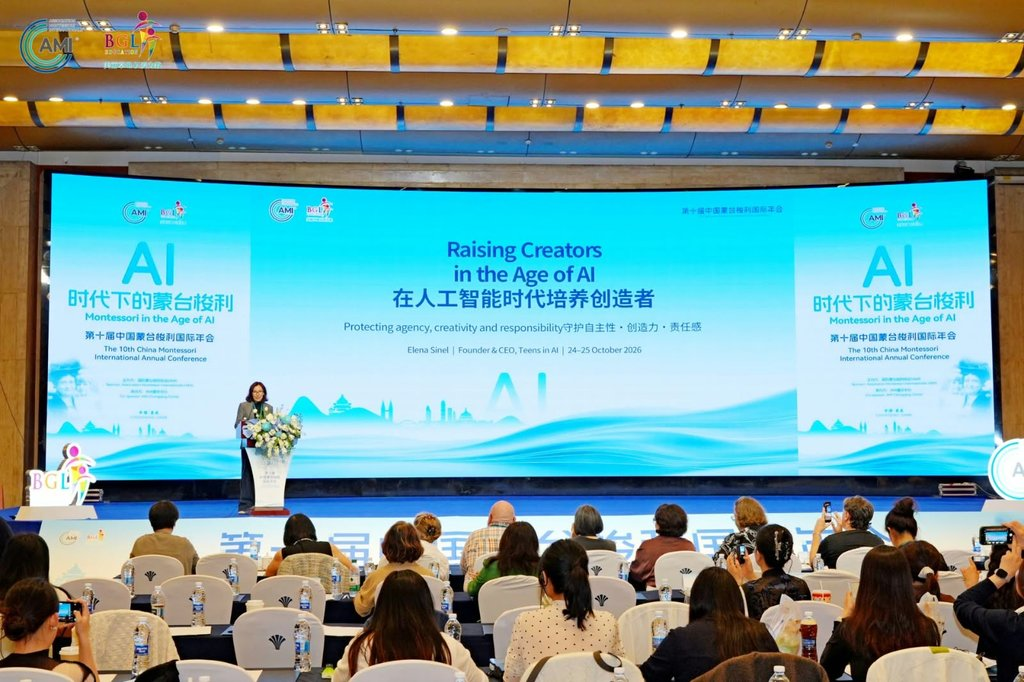
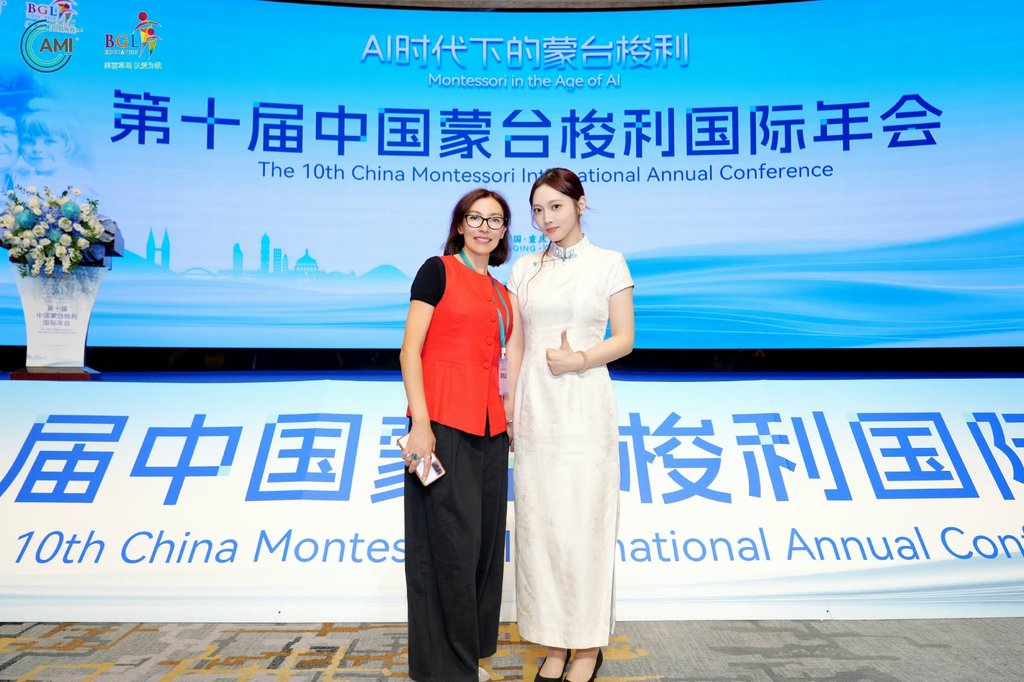
At the Montessori International Conference in Chongqing, China, on 24–25 October 2026, Elena Sinel, Founder & CEO of Teens in AI, delivered a keynote on protecting children’s agency, creativity and responsibility as artificial intelligence becomes increasingly capable.
📆 24-25 October 2026
📍 Chongqing, China
🎤 Keynote speech on Raising Creators in the Age of AI: Protecting Agency, Creativity and Responsibility from Childhood to Adulthood
How can educators embrace the benefits of artificial intelligence while ensuring children continue to develop the skills, independence and judgement they need to thrive? This was the central question explored by Elena, in her keynote speech.
Titled Raising Creators in the Age of AI: Protecting Agency, Creativity and Responsibility from Childhood to Adulthood, the presentation examined how educators can integrate AI into learning while keeping children’s development at the centre of educational decisions.
Supporting thinking, not replacing it
Drawing on research into AI-assisted learning and classroom practice, Elena highlighted an important distinction: a correct answer is not necessarily evidence of learning. AI can help learners explore ideas, receive explanations and check their understanding. However, when it completes tasks on their behalf, it can reduce opportunities to practise independent thinking and develop deeper understanding. The challenge for educators is therefore not simply whether to use AI, but how to use it in ways that strengthen children’s ability to reason, question, collaborate and learn independently.
Elena explored research examining how AI can support educators, including evidence on AI-assisted tutoring and guided classroom problem-solving. The emphasis was on the role of the educator in creating the conditions for meaningful learning, with technology supporting rather than replacing human judgment.
A developmental approach to AI education
The keynote considered how the relationship between children and technology should evolve as they grow, drawing on Montessori principles of exploration, independence and learning through experience. For younger children, the priority is hands-on experience of the real world, with opportunities to explore before turning to digital tools for answers.
As children grow, educators can encourage them to notice, ask questions, test ideas and rethink their conclusions. This includes learning to recognise when AI-generated information may be inaccurate and developing the habit of checking and verifying what a tool produces. For adolescents, the conversation extends beyond learning to the wider implications of AI for relationships, identity, deepfakes, surveillance, power and bias. Young people need opportunities to understand these issues and consider the responsibilities that come with creating and using AI.
From AI consumers to responsible creators
A key message of the presentation was the importance of preparing young people to become creators, not simply consumers, of AI technology. Through its work, Teens in AI encourages young people to identify real-world challenges, consider their potential impact and develop responsible solutions using technology. Elena highlighted a project by the winning team from Ukraine in the 2024 International Women’s Day Techathon. The team addressed communication barriers experienced by people with hearing impairments when interacting with hearing individuals, illustrating how young people can identify a need and apply their ideas to a meaningful problem.
This approach places human needs and responsibility at the centre of technological creation, helping young people consider not only what they can build, but why it matters and whom it serves.
Five questions for educators to consider
Elena concluded by proposing five reflective questions to help educators assess the role of AI in children’s learning:
- What developmental need does this serve?
- Who is doing the thinking?
- What experience might it replace?
- Who remains accountable?
- What can the child do without the tool?
These questions offer a practical starting point for conversations about AI in education, encouraging educators to look beyond what technology can do and consider what children need to learn, experience and develop for themselves.
Preparing young people for an AI-shaped future
As AI continues to change how people learn, work and create, protecting human capabilities remains essential. Analytical thinking, creativity, adaptability and curiosity will continue to matter, alongside the ability to evaluate information, understand consequences and take responsibility for decisions. At Teens in AI, this belief underpins our commitment to responsible AI education, critical AI literacy and giving young people opportunities to apply their skills to real-world challenges.
The goal is not simply to prepare children to use the technology available today. It is to equip them to question it, shape it and contribute to a future in which AI serves people and society.
Learn. Question. Create.
If you are an educator and want to bring critical AI literacy into your classroom:



 Smart, Safe, and Sceptical