
Teens in AI Founder & CEO calls for stronger AI literacy, safeguards and accountability as AI becomes part of young people’s daily lives
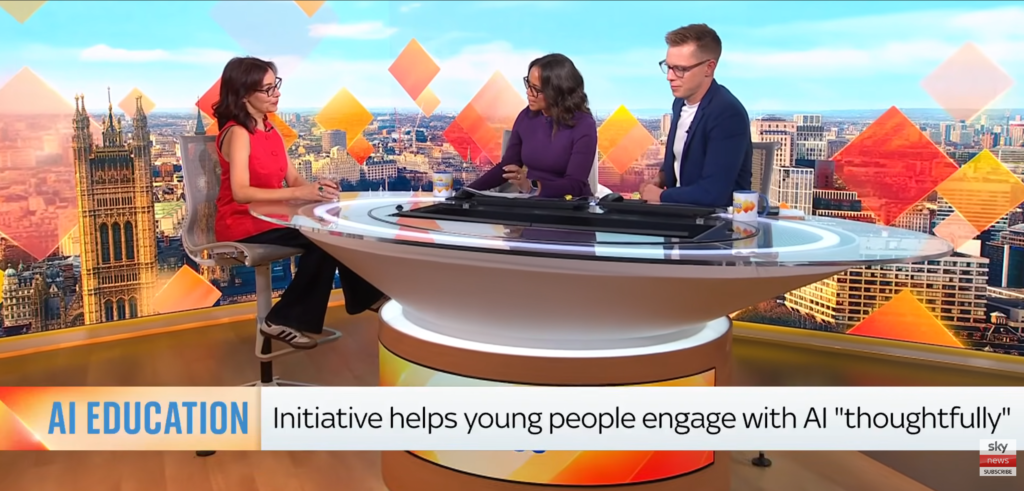
Elena Sinel, Founder and CEO of Teens in AI, joined Sky News Breakfast anchors Leah Boleto and Gareth Barlow to discuss the growing role of artificial intelligence in the lives of children and young people.
📅 Friday, 12 June 2026
⏰ 08:15
🏢 Sky News Breakfast Live
The interview explored a critical issue facing parents, educators, policymakers and technology companies alike: as AI becomes increasingly embedded in everyday life, how do we ensure young people can use it safely, responsibly and with confidence? They discussed the harsh realities of teenagers using AI, with some experiencing hallucinations and psychosis after using it daily.
Elena said they have been building these ‘friendships’ without realising that the tech ‘is a bunch of mathematical formulas and algorithms’.
Young people are already using AI
During the discussion, Elena highlighted that the challenge is no longer whether young people are using AI. They already are. Across schools and homes, young people are engaging with AI-powered tools for learning, creativity, information gathering and everyday problem-solving. Increasingly, however, some are also turning to conversational AI systems for advice, support and companionship.
While these technologies can offer valuable assistance, Elena emphasised that they also present new safeguarding challenges that society is only beginning to understand.
“The concern is not that young people are using AI. The concern is that many are using it every day without being taught what it is, how it works, what it gets wrong, or how it may affect them emotionally.” – Elena Sinel, Founder & CEO of Teens in AI
AI literacy must go beyond technical skills
A key theme of the interview was the need for critical AI literacy.
As AI systems become more sophisticated and human-like in their interactions, young people need the knowledge and skills to understand what these tools are, recognise their limitations, question their outputs and make informed decisions about when and how to use them.
At Teens in AI, this means helping young people develop not only technical understanding, but also the ability to think critically about AI’s impact on society, ethics, privacy, wellbeing and decision-making.
Safeguarding in the age of AI
➡️ The discussion also addressed growing concerns around children forming emotional attachments to chatbot systems.
➡️ While AI tools can appear empathetic, conversational and supportive, Elena stressed that they are not replacements for trusted human relationships.
➡️ Children and young people must understand the difference between interacting with a machine and seeking guidance from parents, teachers, counsellors or other responsible adults.
➡️ As AI tools become more widely available, Elena argued that safeguarding standards and accountability mechanisms must evolve alongside the technology.
➡️ The same level of scrutiny applied to other products and services used by children should be considered for AI systems that are accessible to young users.
Teens in AI’s White paper, The AI Readiness Gap Starts Early
➡️ The importance of early AI literacy and access.
➡️ Elena highlighted the growing gap between young people who have structured exposure to AI and those who do not, and how this disparity shapes confidence, opportunity, and participation in future-facing careers.
➡️ This aligns with Teens in AI’s wider research and advocacy work on AI education equity, including its white paper: 🔗 The AI Readiness Gap Starts Early

 Smart, Safe, and Sceptical