
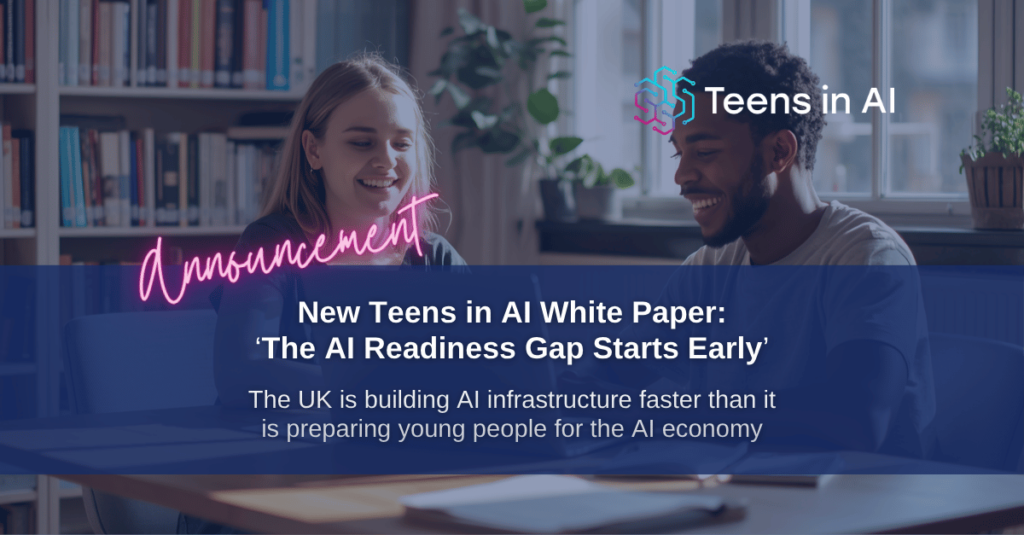
Teens in AI’s May 2026 finds nearly half of young people say school is not preparing them for an AI future – even as daily AI use becomes the norm.
London, UK – 8 June 2026 –🔗 Teens in AI, the UK-based global social impact initiative focused on preparing young people for the future of artificial intelligence and emerging technologies, has published a new White Paper warning that the UK risks deepening inequality and shortfalling on skills unless AI readiness is treated as a national education priority rather than an afterthought to infrastructure investment.
The AI Readiness Gap Starts Early, published today, draws on original May 2026 research from young people across a broad demographic. The findings reveal a generation that is ambitious, already deeply embedded in AI use – and largely unsupported by the structures around them:
- Nearly 70% of young people already use AI tools every day
- 94% can imagine themselves in a future role involving AI
- Yet 48% say school is not preparing them for a future shaped by AI
- 56% say hands-on projects and practical learning would help most
The ambition is there. The pathway is not – and the consequences of that gap are not abstract. The World Economic Forum projects that 39% of workers’ core skills will change by 2030. Without earlier and more deliberate intervention, the AI economy risks reproducing existing inequalities at greater speed and scale.
The paper argues that 2026 represents a critical policy moment. AI Growth Zones have been designated across Great Britain – including in the North East of England, where QTS/Blackstone has committed £10 billion to a new data centre with the potential to support up to 5,000 jobs, and a regional target has been set for 80,000 local students to benefit from AI training by 2029. The Sovereign AI Fund is backing British AI companies with up to £10 million per investment. Yet schools are still navigating AI adoption without consistent guidance, teacher confidence or sufficient support. The infrastructure investment is real. The education pipeline is not keeping pace.
In June 2026, the Government announced further investment in AI bootcamps, entry-levelpathways and technology training for young people entering the workforce. These initiatives are important. However, they largely operate at the point where young people are already transitioning into employment. The question remains whether enough is being done earlier in the pipeline to build AI literacy, confidence and aspiration during secondary education.
Elena Sinel, Founder and CEO of Teens in AI, said: “The AI readiness gap does not begin at the point of hiring. It begins much earlier – in who gets exposed, who is encouraged, who builds confidence, and who learns to question the systems shaping their future. The UK has made significant commitments to becoming an AI maker. But these investments will only deliver their full potential if young people are being prepared now, in schools, with the support of industry and the direction of Government.”
Lord Clement-Jones CBE, Member of the House of Lords, and co-author of the Government-commissioned Skills in the Age of AI Report 2025 adds: “Ambition and delivery on AI education are not yet aligned, and the young people who stand to lose most from that gap are those already least well served. … AI literacy and practical skills must be embedded in the curriculum well before young people enter the workforce – not left to the goodwill of individual schools or the reach of voluntary industry programmes.”
The White Paper also highlights that current responses remain fragmented, with schools, employers and policymakers too often operating in parallel rather than through coordinated, long-term pathways. It points to cross-sector collaboration as the model that works – citing how industry can engage upstream through mentoring, challenge briefs and skills development, rather than only at the point of recruitment.
The White Paper calls for a National Secondary-Age AI Readiness Programme for ages 11–18; AI readiness commitments attached to all AI Growth Zones; greater investment in teacher CPD and responsible AI support; scaled project-based and challenge-led learning; earlier employer engagement before the point of recruitment; and youth voice embedded within AI policy and skills programmes.
The full White Paper is available immediately from Teens in AI here:
– Ends –
About Teens in AI
🔗 Teens in AI is a multi-award-winning global initiative launched in 2018 at the United Nations AI for Good Global Summit. Active in more than 100 countries, it equips young people aged 13 to 18 with the skills, confidence, and understanding needed to design responsible AI solutions that address societal challenges. The organisation delivers hands-on learning through global hackathons, live programmes, and its 🔗 AI Adventures online, self-paced MOOC courses, enabling young people to explore AI concepts, collaborate with peers and industry experts, and develop projects aligned with the United Nations Sustainable Development Goals. Teens in AI also provides training for 🔗 teachers on the safe and ethical use of AI systems, supporting schools to integrate AI literacy across the curriculum. Committed to a more diverse and equitable tech ecosystem, Teens in AI prepares the next generation for an AI-driven future.
For more information, please contact:
Media enquiries: Bev Chislett, Head of Marketing, Teens in AI bev.chislett@teensinai.com
Website: 🔗 www.teensinai.com
AI Adventures Learning Platform: 🔗 https://learn.teensinai.com/

 Smart, Safe, and Sceptical