When I started working with young people over a decade ago, the idea that teenagers could shape AI seemed ambitious – even unrealistic. AI was “for experts”, tucked away in labs and advanced university courses. Young people, especially from underrepresented backgrounds, were rarely invited into these conversations.
Author: Elena Sinel, Founder & CEO, Teens in AI
Today, AI is everywhere: in classrooms, workplaces, healthcare systems, and governments. It influences the stories we read, the jobs we do, and the decisions that shape society. But one thing hasn’t changed enough: who gets to shape these systems.
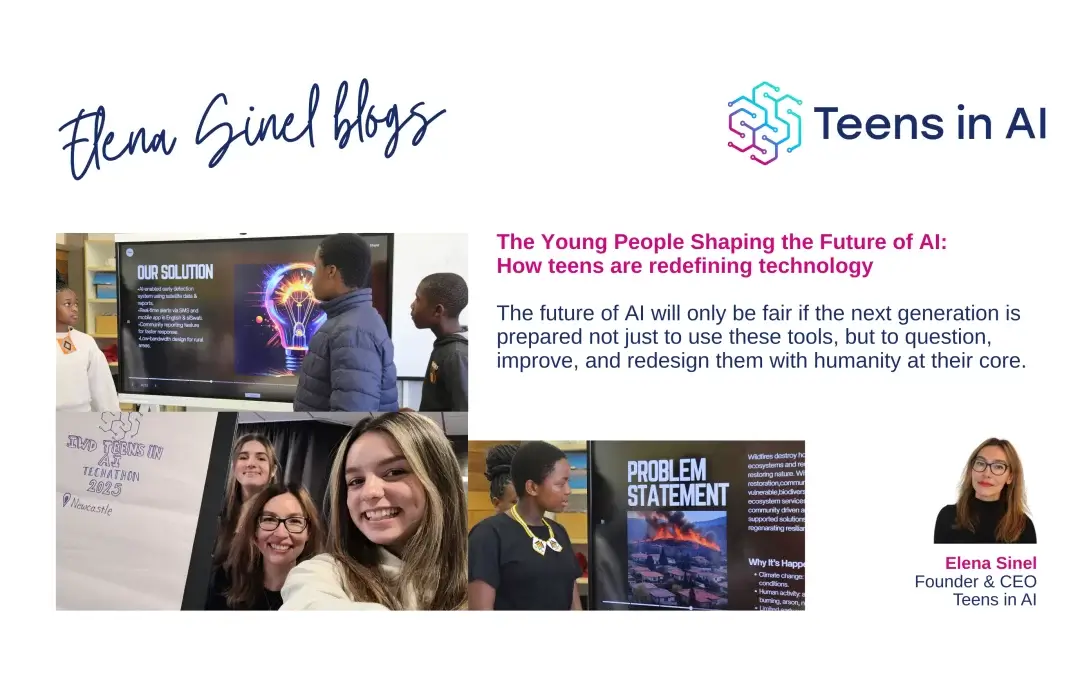
The future of AI will only be fair if the next generation is prepared not just to use these tools, but to question, improve, and redesign them with humanity at their core.
Diversity drives better AI
At Teens in AI, we work with 12–18-year-olds across 100+ countries. In 2024, 80% came from diverse ethnic backgrounds, 69% from state schools, and 57% identified as girls. These aren’t just stats – they are the foundations of a tech sector that finally reflects society.
Yet in the UK, women hold just 22% of AI roles, and people from minority ethnic backgrounds occupy only 15% of tech positions. When technology is built by a narrow group, solutions fail to work for everyone and old biases persist.
Diversity isn’t a bonus in AI development – it’s infrastructure. Inclusion ensures fairness, creativity, and innovation.
Starting young matters
If we wait until university or adulthood to teach AI literacy, it is already too late.
At the UKAI Roundtable in Parliament I contributed to, policymakers recognised the urgency. The AI skills gap is widening, but most government initiatives still focus on reskilling adults. Meanwhile, The World Economic Forum’s Future of Jobs Report 2025 forecasts that tomorrow’s roles will demand creativity, ethics, and digital fluency – skills that start forming long before 18.
On 5 November 2025, the UK Government released its response to the Curriculum and Assessment Review: Building a World-Class Curriculum for All. For the first time, AI is recognised not just as a technological shift, but as an educational one. Embedding digital literacy, critical thinking, and AI understanding across subjects is essential.
For years, experts have called for a curriculum that keeps pace with social and technological change. The Review’s emphasis on AI, digital literacy, and critical thinking reflects a consensus: early AI education is vital for employability, civic understanding, and ethical reasoning. Collaboration between government, educators, and social innovators will be key to ensuring all young people benefit.
Teachers are the first step
At Teens in AI, our ‘teach the teachers’ programme equips educators with ready-to-use resources to introduce AI confidently, even without prior experience. When teachers feel equipped, AI literacy becomes part of everyday learning, not a one-off lesson.
Through real-world challenges, young people become creators, critics, and ethical thinkers, developing curiosity, empathy, and confidence to lead responsibly in the future workforce.
Industry as a Partner, not just a Funder
The private sector faces a paradox: demand for AI skills is growing, yet many companies cut junior roles and rely on automation. Short-term efficiency can create long-term vulnerability.
Every algorithm still requires humans who know how to ask the right questions. Innovation thrives on imagination – the kind young people naturally bring.
Our partnerships with Sage, Capgemini, and Red Hat show what’s possible when industry steps up as a collaborator. Together, we design challenges using real data and real needs. Young people learn why responsible AI matters, while businesses gain perspectives they would never uncover alone.
This is not philanthropy. It is a strategic investment in a global, ethical, and diverse workforce.
Education: The only scalable safeguard
AI will always outpace regulation. Education is the long-term safeguard.
Our programmes embed the United Nations Sustainable Development Goals so young people learn not just what AI can do, but what it should do. They explore fairness, bias, ethics, and sustainability – and they build with purpose.
Every year, alumni lead university projects, join apprenticeships, and enter careers in AI ethics, data science, engineering, and policy. Early exposure creates lifelong impact.
A future worth shaping
When I speak with young people, I see optimism as necessary, not naïve. They see AI as a chance to solve problems adults haven’t. They imagine technologies that serve families, communities, and nations, and ask better questions than many seasoned professionals.
The real question is whether we provide the preparation, pathways, and power they need to shape the systems that define their future.
Looking to 2026, AI literacy should be as universal as reading and numeracy. Accessible in every school, embedded across every subject, and available to every young person, regardless of postcode or background.
If we want AI that reflects the best of humanity, we must invest in the people who will build it. The window to act is open now. The next generation is already ready.