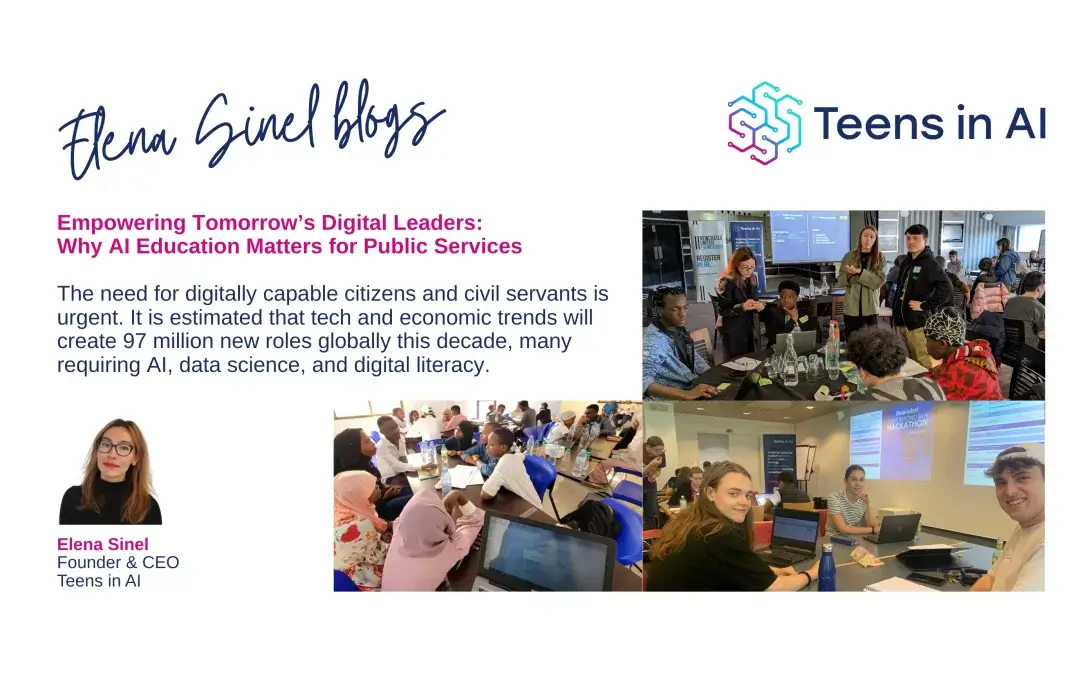
The need for digitally capable citizens and civil servants is urgent. The World Economic Forum’s Future of Jobs Report 2025 estimates that technological and economic trends will create 97 million new roles globally this decade, many requiring AI, data science, and digital literacy.
Author: Elena Sinel, Founder & CEO, Teens in AI
When I launched Teens in AI at the United Nations in 2018, I could not have imagined the impact it would have. What started as a small initiative has now reached over 25,000 young people across 100+ countries. I have seen twelve-year-olds design AI systems to reduce food waste in their communities, build applications to monitor urban air quality, and sixteen-year-olds create models to improve local transport efficiency. Each project, each prototype, is a reminder that when given the right tools, guidance, and purpose, young people can tackle real-world problems with creativity and determination. This is the talent pipeline the public sector cannot afford to ignore.
The need for digitally capable citizens and civil servants is urgent. The World Economic Forum’s Future of Jobs Report 2025 estimates that technological and economic trends will create 97 million new roles globally this decade, many requiring AI, data science, and digital literacy. Yet 92% of jobs today demand digital skills, while one-third of workers still lack foundational competence. In the UK alone, 82% of roles require digital proficiency. Without addressing this skills gap early, public services risk being understaffed by people equipped to manage the technologies shaping society.
From Policy to Practice
My work has taken me from advising members of the UK Parliament at the UKAI Roundtable to meeting the President of Uzbekistan to discuss AI education. Each conversation highlights the same question: how do we prepare young people for a future where technology touches every aspect of public life? Policy frameworks are emerging. The UK Digital Strategy commits to developing the digital skills economy-wide, from apprenticeships to lifelong learning, while programmes fund AI PhDs and dozens of new digital apprenticeship standards. Yet policy alone is not enough; we need a practical, hands-on bridge between learning and career readiness.
On 5 November 2025, the UK Government published its response to the Curriculum and Assessment Review, Building a World-Class Curriculum for All – a long-awaited step towards embedding AI literacy and digital competence across the national curriculum. The response signals an important shift in recognising that AI is not just a technology issue but an education one. It is a welcome direction and reflects growing consensus that AI skills must be seen as foundational to both national competitiveness and civic participation.
At one of our recent hackathons in London, a 14-year-old created an AI prototype to identify mental health challenges within her school. Watching her present, seeing her peers debate ethical questions about data privacy and fairness, I realised that early exposure to digital skills transforms not just technical capability, but confidence, ethical reasoning, and a sense of civic responsibility. These are exactly the qualities public services need – people who can navigate complex challenges, innovate responsibly, and consider the social impact of technology.
Bridging Education and Digital Careers
Bridging education and digital careers is about more than coding. We need to integrate AI into English lessons to explore ethical dilemmas, into Citizenship to examine algorithmic bias, and into Science and Geography to apply AI to environmental and sustainability challenges.
Every project delivered as part of our programmes, is framed with sustainability in mind, aligned with the United Nations Sustainable Development Goals. Young people design solutions that reduce emissions, tackle pollution, or improve energy efficiency in their communities. By embedding ethics, sustainability, and social responsibility into learning, students are better equipped to support government priorities, from decarbonisation to resilient infrastructure.
Governments can help by embedding internationally benchmarked standards into curricula, while creating opportunities for hands-on experience through coding clubs, civic hackathons, and internships. Industry partnerships provide further context. By collaborating with global organisations including Sage and Sage Foundation, Capgemini, Red Hat, other partners and industry experts, our students gain exposure to professional tools and mentorship that prepare them for public service careers. This combination of education, mentorship, and practical experience builds a pipeline of future digital leaders.
AI Skills: Strengthening Public Services
AI skills benefit governments as much as they benefit individuals. In Finland, AI predicts urban traffic flows, helping authorities optimise planning and reduce congestion with 97% accuracy. In Sweden, machine learning systems tailor training pathways for jobseekers while human caseworkers oversee outcomes. Across sectors, AI enables better resource allocation, more responsive healthcare services, and faster administrative processes.
Yet technology is only as effective as the people who design, manage, and interpret it. The UK civil service is investing in upskilling senior leaders and attracting new talent through apprenticeships and fast-track programmes. Globally, governments increasingly integrate AI education into civil service strategies. The more digitally literate public servants are, the better they can ensure AI systems are fair, transparent, and effective. Likewise, educating young people in AI from an early age reduces bias embedded in algorithms, supporting higher quality, equitable AI systems in government.
Ethics and Critical Thinking
AI is not just a tool; it reflects values. UNESCO’s AI Competency Frameworks for Students and Teachers places ethics at the centre, emphasising fairness, transparency, and human-centred design. In practice, teaching students to question datasets, detect bias, and design responsibly nurtures future leaders who deploy technology ethically in public service. Mapping curricula to internationally recognised frameworks – UNESCO and the OECD/EC AILit Framework, (with the The World Economic Forum’s Future of Jobs Report 2025 another useful source) – ensures students graduate with both technical and ethical grounding.
I have seen the difference firsthand. Students engaged in ethical challenges instinctively ask who benefits, who is excluded, and what fairness looks like in practice. These are the same questions governments must ask when implementing AI in health, social care, transport, or justice. Teaching digital skills alongside ethical reasoning ensures that young people are prepared not just to innovate, but to improve society.
A Collaborative, Grassroots Approach
The movement to train digital leaders is not driven by governments alone. It grows from communities, schools, industry, and young people themselves. Students are empowered to run clubs, hackathons, and mentoring schemes, supported by policy frameworks and industry guidance.
This collaborative ecosystem is where innovation thrives. Industry brings technical expertise, governments provide policy and resources, and young people contribute creativity, energy, and perspective. Together, they form the foundation for a new generation of civil servants and public service innovators, capable of applying AI to improve services, tackle sustainability goals, and address pressing societal challenges.
Investing in the Future of Public Services
The UK’s Digital Strategy emphasises that no community should be left behind. By embedding sustainability, ethics, and diversity into learning opportunities, governments can ensure young people are technically capable, socially responsible, and ready to serve.
Investing in digital education is not only about future careers; it is about developing leaders who will shape public services, design fairer systems, and implement technology responsibly.
I often reflect on the impact this can have: well-educated students today become civil servants and policymakers tomorrow. They understand AI not as a tool for efficiency alone, but as a means to improve society, reduce bias, and strengthen public trust. When we invest in young people’s digital skills, we invest in better governance, stronger public services, and a more equitable future.